Showing posts with label creative science. Show all posts

Thursday, 6 October 2022

woman, the scientist

From The Dawn of Everything by David Graeber and David Wengrow:

We can be fairly certain there was no Neolithic equivalent of Edmund Cartwright or Thomas Edison, who came up with the conceptual breakthrough that set everything in motion. Still, it often seems difficult for contemporary writers to resist the idea that some sort of similarly dramatic break with the past must have occurred. In fact, as we’ve seen, what actually took place was nothing like that. Instead of some male genius realizing his solitary vision, innovation in Neolithic societies was based on a collective body of knowledge accumulated over centuries, largely by women, in an endless series of apparently humble but in fact enormously significant discoveries. Many of those Neolithic discoveries had the cumulative effect of reshaping everyday life every bit as profoundly as the automatic loom or lightbulb.
Every time we sit down to breakfast, we are likely to be benefiting from a dozen such prehistoric inventions. Who was the first person to figure out that you could make bread rise by the addition of those microorganisms we call yeasts? We have no idea, but we can be almost certain she was a woman and would most likely not be considered ‘white’ if she tried to immigrate to a European country today; and we definitely know her achievement continues to enrich the lives of billions of people. What we also know is that such discoveries were, again, based on centuries of accumulated knowledge and experimentation — recall how the basic principles of agriculture were known long before anyone applied them systematically — and that the results of such experiments were often preserved and transmitted through ritual, games and forms of play (or even more, perhaps, at the point where ritual, games and play shade into each other).
‘Gardens of Adonis’ are a fitting symbol here. Knowledge about the nutritious properties and growth cycles of what would later become staple crops, feeding vast populations — wheat, rice, corn — was initially maintained through ritual play farming of exactly this sort. Nor was this pattern of discovery limited to crops. Ceramics were first invented, long before the Neolithic, to make figurines, miniature models of animals and other subjects, and only later cooking and storage vessels. Mining is first attested as a way of obtaining minerals to be used as pigments, with the extraction of metals for industrial use coming only much later. Mesoamerican societies never employed wheeled transport; but we know they were familiar with spokes, wheels and axles since they made toy versions of them for children. Greek scientists famously came up with the principle of the steam engine, but only employed it to make temple doors that appeared to open of their own accord, or similar theatrical illusions. Chinese scientists, equally famously, first employed gunpowder for fireworks.
For most of history, then, the zone of ritual play constituted both a scientific laboratory and, for any given society, a repertory of knowledge and techniques which might or might not be applied to pragmatic problems.

Tuesday, 15 September 2020

the great danger of the metric system

A few fact(oid)s about Dame Agatha Christie I haven’t been aware until now.

  • Pharmacy and toxicology were among Christie’s many interests. During the the First World War, she took some time off her work as a nurse to study for the Apothecaries Hall Examination. She wrote in her autobiography:
    To be introduced suddenly to the periodic table, atomic weight, and the ramifications of coal-tar derivatives was apt to result in bewilderment. However, I found my feet, mastered the simpler facts, and after we had blown up our Cona coffee machine in the process of practising Marsh’s test for arsenic our progress was well on the way. <...>
    A chemist’s shop, the first time that you go behind the scenes, is a revelation. Being amateurs in our hospital work, we measured every bottle of medicine with the utmost accuracy. When the doctor prescribed twenty grains of bismuth carbonate to a dose, exactly twenty grains the patient got. Since we were amateurs, I think this was a good thing, but I imagine that any chemist who has done his five years, and got his minor pharmaceutical degree, knows his stuff in the same way as a good cook knows hers. He tosses in portions from the various stock bottles with the utmost confidence, without bothering to measure or weigh at all. He measures his poisons or dangerous drugs carefully, of course, but the harmless stuff goes in in the approximate dollops. Colouring and flavouring are added in much the same way. This sometimes results in the patients coming back and complaining that their medicine is a different colour from last time. <...>
    During the course of my pharmaceutical instruction on Sunday afternoons, I was faced with a problem. It was incumbent upon the entrants to the examination to deal with both the ordinary system and the metric system of measurements. My pharmacist gave me practice in making up preparations to the metric formula. Neither doctors nor chemists like the metrical system in operation. One of our doctors at the hospital never learned what ‘containing 0.1’ really meant, and would say, ‘Now let me see, is this solution one in a hundred or one in a thousand?’ The great danger of the metric system is that if you go wrong you go ten times wrong. <...>
    It was while I was working in the dispensary that I first conceived the idea of writing a detective story.
  • It was not until 1920 that her first novel, The Mysterious Affair at Styles, saw the light of day. The corresponding episode of Poirot was released 30 years ago on occasion of Christie’s 100th birthday. Now, to mark the centenary of Styles, the Royal Mint issued the new £2 coins featuring the author’s signature, a jigsaw puzzle and some instruments of murder.

  • I visited Ayuntamiento de Las Palmas de Gran Canaria on many a bureaucracy-related occasion without knowing that its (pretty ugly) headquarters occupy the place of the former Quiney’s Hotel Metropole where Agatha Christie stayed in 1927.
    Las Palmas is still my ideal of the place to go in the winter months. I believe nowadays it is a tourist resort and has lost its early charm. Then it was quiet and peaceful. Very few people came there except those who stayed for a month or two in winter and preferred it to Madeira. It had two perfect beaches. The temperature was perfect too: the average was about 70, which is, to my mind, what a summer temperature should be.
    Agatha Christie: An Autobiography

  • The Mousetrap was not only the longest-running West End show but it had the longest initial run of any play in history. It premiered in 1952 and ran continuously until March 2020 until it was rudely interrupted by the COVID-19 pandemic.

Friday, 18 March 2016

evolve or perish

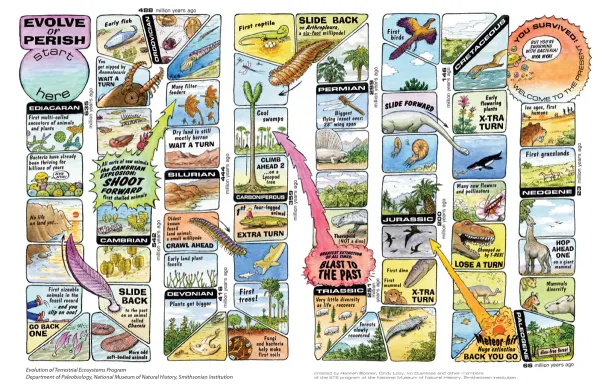
In my first two-and-a-bit months working as a science teacher, there were only a few things that actually worked. And when I say “worked”, I mean made those incredibly lazy and bored pupils of mine to pay any attention for more than a minute. In case of Evolve or Perish, it worked for a good half an hour with Grade 7. They even might have learned something about geologic periods.

The preparation is minimal: you just have to print out the two pages of the game. Then tell the students to trim and glue them together to make a “board”. That’ll keep them busy for additional ten—fifteen minutes. If you have even more time to spare, you can print out the black-and-white version and then ask them to colour it. Then you’ll need dice and counters. I bought a box of four dice and I don’t know how many counters in a Chinese shop for €1. Three-four players per board work the best.

I didn’t expect that the Grade 11 students, better behaved but even more bored, to enjoy it as much if not more than Grade 7. But here they were, suddenly wide awake, rolling their dice and shouting “¡Ñoss!” when landing on “blast to the past”. What’s more, when they finished, they started from the beginning. One team played two games, another three games. All without me telling them what to do. Marvellous.

Tuesday, 8 December 2015

lol my thesis

What, lol my thesis blog wasn’t updated for a month? That sucks. According to its creator, Angela Frankel,

Initially intended as a means of procrastination from my own thesis, this blog has documented some of the stress, hilarity, and chaos associated with undergraduate (and some post-graduate) theses.

In fact it serves to illustrate that most of the theses out there are simply not worth the paper they are printed on, or maybe even the disk space they occupy. They would be totally disposable if not for lol my thesis. Just think about that before adding “M.Sc.” or “Ph.D.” to your name. (What if I modify my CV by replacing “Ph.D.” with “Ph.D.LOL”? I don’t think anybody would notice.) Could it be that it’s not updated any longer because at long last people have realised that? I seriously doubt it.

Here are some of my favourites.

Sunday, 9 December 2012

Sir Patrick Moore (1923—2012)

Moore was perhaps the last in the great British tradition of significant contributions to science by distinguished amateurs, and was fiercely proud of his amateur status.

I wonder what academic bureaucrats of today would make of Sir Patrick Moore’ CV if he ever applied for professorship. Moore never went to the university (he famously refused a government grant to study at Cambridge), let alone wrote a Ph.D. thesis. So what. Dennis Barker wrote in The Guardian:

With one exception after his teaching days — his directorship of Armagh Planetarium in Northern Ireland (1965—68) — Moore was never an employee.

Even better.

I first learned about Moore from Англия, a British magazine published (in Russian) in Soviet times. I remember the black and white photo of him by the grand piano, the caption saying that Moore is an accomplished musician possessing perfect pitch. Back then, I thought he was some sort of English eccentric. Many years later, I saw him on the BBC. Yes he was an archetypal English eccentric all right, and amazingly brilliant at that. He joined the RAF during World War II; he met Yuri Gagarin and appeared in Doctor Who. He was the world’s longest-serving TV presenter — and, briefly, the finance minister for the Monster Raving Loony Party. According to Wikipedia, “as a pianist, he once accompanied Albert Einstein playing The Swan by Camille Saint-Saëns on the violin”. He wrote hundreds of books, including the one called Bureaucrats: How to Annoy Them. So I think his application would not be successful.

Saturday, 26 May 2012

putting the spheres back into tetrahedra

This post has its roots in a discussion during the coffee-time, inspired by an almost empty jar of condensed milk. It seemed obvious that spherical jars do not pack as good as cylindrical jars. But how good do they pack? Some scribbling ensued.

Realising that solving the problem from the first principles might take much more than quarter an hour, I looked up the problem of close-packing of spheres, seemingly one of easier packing problems, in Wikipedia. I thought it was solved ages ago. I was wrong (or only partially right, if we are optimists.)

Sir Walter Raleigh posed so-called Cannonball Problem around 1587 to the English polymath Thomas Harriot, his scientific adviser on the expedition to the New World. Later, the correspondence of Harriot with Johannes Kepler influenced the Kepler conjecture (1611), which says that no arrangement of equally sized spheres filling space has a greater average density than that of the face-centered cubic (fcc) packing and hexagonal close packing (hcp) arrangements. Gauss proved in 1831 that the average density of close-packed spheres is π/√18 ≃ 74%. (Compare that with circle packing — or cylinder packing — density of π/√12 ≃ 90.7%.)

In 1998 Thomas Hales announced that the proof by exhaustion of Kepler conjecture was complete. It took four years for a twelve-strong panel of referees to agree with 99% certainty that Hales’s proof is correct. (How did they do that?) However a complete formal proof is still to be produced — Hales’s Flyspeck Project is said to last at least twenty more years.

What is the best container for close-packed spheres? At first, I naïvely thought that, if one can stack spheres as tetrahedral pyramids, maybe tetrahedral boxes? Provided, of course, that one knows what to do with tetrahedral boxes. Another discovery awaited me. Aristotle wrote in 350 BC in his treatise On the Heavens:

It is agreed that there are only three plane figures which can fill a space, the triangle, the square, and the hexagon, and only two solids, the pyramid and the cube.

It is somewhat reassuring that until recent I shared with great Aristotle the belief that one can fill space with regular tetrahedra. On the other hand, it is not. It was known at least since fifteenth century that these polyhedra do not tile space. Interestingly, the optimal packing for regular tetrahedra remains to be found. The best known packing of 85.63% was achieved as recently as 2010. Of course it is much better than 74% density of spheres, but maybe there is still room for improvement.

Even so, as this diagram shows, one can quite nicely stack the balls in more convenient cubic boxes, which do tile space for sure.

What, if any, is the moral of the story? Not every statement starting with “It is agreed that...” is true. The old problem does not mean it is a solved problem. You might as well have a go at it. Or, at least, read in Wikipedia about it.

Update (25.05.2023): The Flyspeck Project was completed in 2014 and a formal proof of the Kepler conjecture was published in 2015.

Monday, 25 July 2011

inflated importance, unreal deadlines

From Structured Procrastination by John Perry:
The list of tasks one has in mind will be ordered by importance. Tasks that seem most urgent and important are on top. But there are also worthwhile tasks to perform lower down on the list. Doing these tasks becomes a way of not doing the things higher up on the list. With this sort of appropriate task structure, the procrastinator becomes a useful citizen. Indeed, the procrastinator can even acquire, as I have, a reputation for getting a lot done.
The trick is to pick the right sorts of projects for the top of the list. The ideal sorts of things have two characteristics, First, they seem to have clear deadlines (but really don’t). Second, they seem awfully important (but really aren’t). Luckily, life abounds with such tasks. In universities the vast majority of tasks fall into this category, and I’m sure the same is true for most other large institutions.
One needs to be able to recognize and commit oneself to tasks with inflated importance and unreal deadlines, while making oneself feel that they are important and urgent.

Monday, 8 February 2010

what’s wrong with science blogging?

There was an interesting post by David Crotty entitled Science and Web 2.0: Talking About Science vs. Doing Science on The Scholarly Kitchen blog.
Even without new online technologies, scientists already spend a substantial portion of their time communicating. They share results with peers, plan future experiments with collaborators, give talks, write papers, teach, etc.
Frankly, I don’t see why any of these activities are incompatible with blogging. Quite the reverse: blogging can be a way to improve the communication. If you give a presentation, whether at a conference or in a classroom, why not to post it online? And is there any better way to share your results than to blog about them?
New social media endeavors ask scientists to devote even more time to communication, but it’s unclear where participants are supposed to find that time. Every second spent blogging, chatting on FriendFeed, or leaving comments on a PLoS paper is a second taken away from other activities. Those other activities have direct rewards towards advancement. It’s hard to justify dropping them for activities backed by vague promises that “you will be one of the early adopters and will be recognized and respected for this in the future.” That’s a tough gamble for most to take, and scientists are unlikely to risk current status for a leg up in the event that sweeping societal changes occur in how we fund, employ, and judge scientific achievement.
Thus, it is inherent conservatism of those who are “unlikely to risk current status” that prevents the scientific community from embracing new technology. If so, then that’s too bad for science. But really, should we worry?

The author discriminates between scientists and people who talk about science, for example... teachers. Excuse me. I heard there are many people in academia whose positions include a lot of teaching. On the one hand, “scientists are no different than other humans” (and most people don’t blog, ergo most scientists shouldn’t either). On the other hand, it is implied that they require the communication tools different from “mainstream” ones. I do recall that in 1980s there was a belief that scientific computing should be done on specialised workstations, not PCs or Macs. Now most of the scientific computing is done exactly on the same PCs and Macs.

The blogging in science may never become a mainstream activity. Or maybe it is the future of scientific communication. Consider this: people blog because they like blogging, not because they have nothing else to do. Also, people go to science because science is fun. While writing grant proposals and, in most cases, writing research papers is not fun. (That also explains why reading grant proposals and most research papers is not fun either.) The sooner scientists leave these not-fun activities behind, the better. Or so one can hope.

Thursday, 7 January 2010

loose ends

Ten years ago or so, I attended the lecture of Sydney Brenner. And what a treat it was. He managed to keep the audience’s attention for an hour without showing a single slide or using any other prop.

Sunday, 13 September 2009

карта звезды

When I was about four years old, I was drawing all the time. Once, in kindergarten, I was creating another masterpiece of an illustrated sci-fi book, which included the map of a star.

Saturday, 12 September 2009

science is cool

Science is not all about the books. It can be cool, filled new and creative, fun ideas.

This blurb for Mitochondria video by Michelle Bell can be applied to all of ChloroFilms, a collection of “videos illustrating the remarkable aspects of plant life”. Don’t dismiss it as stuff for (or by) undergraduates: for example, The Science of Cool by Sharon Robinson is an overview of her original research in Antarctic mosses. My favourites are La Bloomba by Kris Holmes and The Fastest Flights in Nature by Hayley Kilroy.

Sunday, 16 August 2009

cool badges

The Science Scouts develop some seriously cool badges. For all humankind.

Anyone is welcome to use these badges, although a link to this site (or the specific badge entry) is much appreciated. Even better is if you provide an anecdote in the comments section to explain your reasons for awarding yourself the badge.

Excellent. I allow myself to award myself a few.