Tuesday, 15 May 2012

Hottabych principle

Two Young Pioneers, Volka and Zhenya, take the old genie Hassan Abdul-rahman ibn Khattab, aka “Hottabych”, to the football match. As the boys did not bother to explain the rules of the game to Hottabych, he had to figure them out himself.

The object of the game is not possession of the ball but to score more goals at the end of the game than the opposing team — something that is not immediately obvious in a match that can go for ninety minutes without scoring a single goal. So Hottabych decides to give each player a ball of his own. As I just learned, in Russian-language cyberspace this approach to football (and its extensions) is referred to as Принцип Хоттабыча (“Hottabych principle”).

— Не сочтёшь ли ты, о Волька, возможным объяснить твоему недостойному слуге, что будут делать с мячом эти двадцать два столь симпатичных мне молодых человека? — почтительно осведомился Хоттабыч.
Но Волька в ответ только нетерпеливо отмахнулся:
— Сейчас всё сам поймёшь.
Как раз в этот момент форвард «Зубила» звонко ударил носком бутсы по мячу, и матч начался.
— Неужели этим двадцати двум приятным молодым людям придётся бегать по столь обширному полю, терять силы, падать и толкать друг друга только для того, чтобы иметь возможность несколько мгновений погонять невзрачный кожаный мячик? И всё это лишь потому, что на всех нашелся для игры только один мяч? — недовольно спросил Хоттабыч через несколько минут.
Но Волька, увлечённый игрой, и на этот раз ничего старику не ответил. Было не до Хоттабыча: нападение «Шайбы» завладело мячом и приближалось к воротам «Зубила».
— Знаешь что, Волька? — шепнул своему приятелю Женя. — Мне кажется, просто счастье, что Хоттабыч ничего не понимает в футболе. А то бы он тут таких дров наколол, что ой-ой-ой!
— И мне так кажется, — согласился с ним Волька и вдруг, ахнув, вскочил со своего места.
Одновременно с ним вскочили на ноги и взволнованно загудели и все остальные восемьдесят тысяч зрителей.
Пронзительно прозвучал свисток судьи, но игроки и без того замерли на месте.
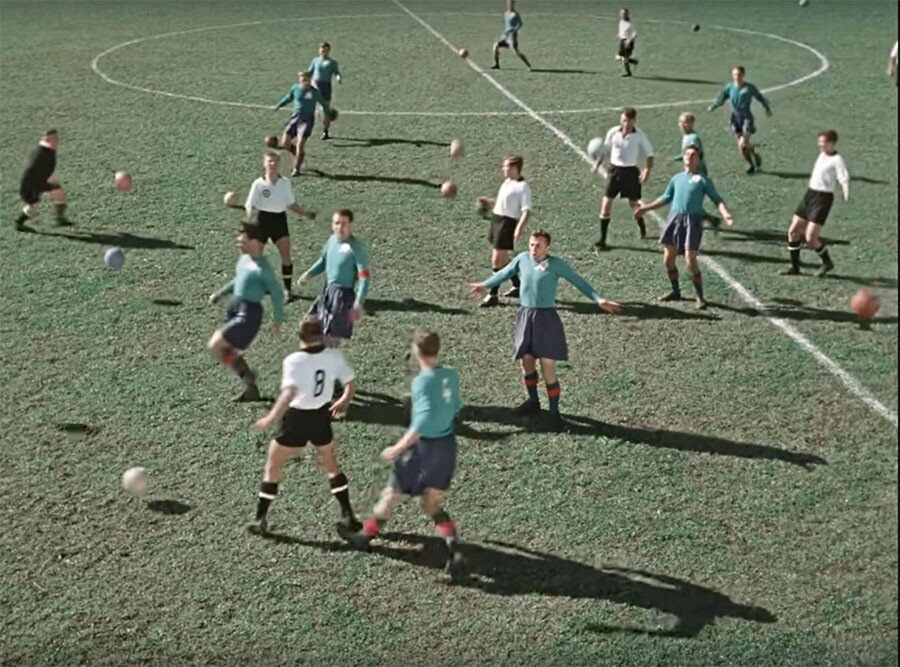
Случилось нечто неслыханное в истории футбола и совершенно необъяснимое с точки зрения законов природы: откуда-то сверху, с неба, упали и покатились по полю двадцать два ярко раскрашенных мяча. Все они были изготовлены из превосходного сафьяна.
“Will you, O Volka, consider it possible to explain to your unworthy servant what these twenty-two pleasant young men are going to do with the ball?” Hottabych asked respectfully.
Volka waved his hand impatiently and said, “You’ll see for yourself in a minute.”
At that very moment a Zubilo player kicked the ball smartly and the game was on.
“Do you mean that these twenty-two nice young men will have to run about such a great field, get tired, fall and shove each other, only to have a chance to kick this plain-looking leather ball around for a few seconds? And all because they gave them just this one ball for all twenty-two of them?” Hottabych asked in a very displeased voice a few minutes later.
Volka was completely engrossed in the game and did not reply. He could not be bothered with Hottabych at a time when the Shaiba’s forwards had got possession of the ball and were approaching the Zubilo goal.
“You know what, Volka?” Zhenya whispered. “It’s real luck Hottabych doesn’t know a thing about football, because he’d surely stick his finger in the pie!”
“I know,” Volka agreed. Suddenly, he gasped and jumped to his feet.
At that very moment, the other hundred thousand fans also jumped to their feet and began to shout. The umpire’s whistle pierced the air, but the players had already come to a standstill.
Something unheard-of in the history of football had happened, something that could not be explained by any law of nature: twenty-two brightly coloured balls dropped from somewhere above in the sky and rolled down the field. They were all made of top-grain morocco leather.

At this point, the referee stops the game, depriving us of the opportunity to see what could happen next. On one hand, the players are saturated with footballs. So passing the ball is possible but not really needed. Ditto tackling the opponent, unless you know what to do with two or more footballs. On the other hand, the object of the game remains the same. One still can score, and one still can defend. Of course, that requires an adjustment of the rules and some extra skills. I wonder how many footballers would be up to challenge.

As it happens, most of the magic performed by well-meaning Hottabych is not welcome. This has nothing to do with the fact that the old genie finds himself in the 1930s USSR, even though both the book and the film have their fair share of Soviet propaganda.

Much of the comedy is based on old Hottabych failing to understand what people really mean when they express their wishes. Or is it people who cannot formulate their wishes clearly and frankly? I think that the latter is true, and genie is brought into the picture simply to demonstrate that.

When a wish is granted, especially by a genie, you may come to realise that it is not what you actually want or need. For example, to possess the ball in the game of footie is an opportunity, not an end in itself. Twenty-two balls falling from the sky serve to prove it.

I suspect there is no scientist alive who never dreamed of getting a Nobel Prize. Imagine that Hottabych, in form of the Nobel Committee, awards you a Nobel Prize, sparing you years of tedious experiments, paper writing and other activities that scientists habitually torture themselves with. Will you be happy? I guess not. To quote Russell W. Belk, “the gift of an award may be a Trojan horse that destroys our initiative for further achievements”. Or, as Mikhail Zhvanetsky put it: «Процесс — жизнь, результат — смерть» (“Life is the process; death is the result”).

Friday, 9 March 2012

against intellectual property

From Against Intellectual Property by Brian Martin:

Few scientists complain that they do not own the knowledge they produce. Indeed, they are much more likely to complain when corporations or governments try to control dissemination of ideas. Most scientists receive a salary from a government, corporation or university. Their livelihoods do not depend on royalties from published work.

Saturday, 21 January 2012

an absolute sinecure

From Dirk Gently’s Holistic Detective Agency by Douglas Adams:

Indeed, it was not entirely clear if Reg had ever taught anybody at all and what, if anything, he would have taught them. His professorship was an obscure one, to say the least, and since he dispensed with his lecturing duties by the simple and time-honoured technique of presenting all his potential students with an exhaustive list of books that he knew for a fact had been out of print for thirty years, then flying into a tantrum if they failed to find them, no one had ever discovered the precise nature of his academic discipline. He had, of course, long ago taken the precaution of removing the only extant copies of the books on his reading list from the university and college libraries, as a result of which he had plenty of time to, well, to do whatever it was he did.

Friday, 30 December 2011

sniff talks to the professor

From Comet in Moominland by Tove Jansson:

“But how do you know that the Observatory is on that peak especially?” asked Sniff, craning his neck to see the top, but without success as it was hidden in the clouds.
“Well,” answered Snufkin, “you only have to look at the ground just here. It’s covered with cigarette ends which have obviously been thrown out of the windows by those absent-minded scientists up there.”

Tuesday, 1 November 2011

to collaborate or not to collaborate

A few quotes from a fascinating new book, Collaborative Computational Technologies for Biomedical Research (Wiley, 2011):

Even within an institution — which should be legally, strategically, and financially incented for alignment, and for maximizing the opportunities for internal collaboration — barriers still exist. The subunits of the institution: its departments, its divisions, its components produce collaboration “walls” of varying substantiality. Organizational lore and personal relationships add another layer of “not-invented here” (NIH) culture, and allegiances to local agendas, even to the point of disadvantaging the larger institutional unit. In fact, if we wish to pursue the elimination of collaboration barriers we have to realize that many barriers are not institutional at all. Choices to collaborate or not collaborate are sometimes based not just on current affiliations but on past affiliations, degrees obtained, reputations, and even a less than rational bias as to just who our collaboration partners should be.

Wednesday, 5 October 2011

discoveries today are really not expected

From the telephone interview with Dan Shechtman, the winner of The Nobel Prize in Chemistry 2011:

Q: What do you think your experience of discovering quasicrystals taught you about science?

A: Oh, it taught me... This is a very good question! You know, it taught me that a good scientist is a humble scientist, somebody who is willing to listen to news in science which are not expected. Because discoveries today are really not expected – if they were expected they would have been discovered a long time ago. So something new, that is forbidden by some laws... people have to listen to this. In most cases, the news is not really news. But in some cases, discoveries are made and should be listened to.

Sunday, 11 September 2011

blogging

I have no illusions as to how many people read my blog. True, it was never meant to be read by many, but it is always nice to be reassured. Thank you Despair, Inc.! What about you?

Friday, 19 August 2011

19 August 1991

Do I remember the August Putsch? Yes. Vividly. Early morning Monday, 19 August 1991, I heard the news on the radio. The classical music followed. On the telly, interminable Swan Lake, just like when Brezhnev (later: Andropov) died. I can’t stand Swan Lake ever since.

Monday, 25 July 2011

inflated importance, unreal deadlines

From Structured Procrastination by John Perry:
The list of tasks one has in mind will be ordered by importance. Tasks that seem most urgent and important are on top. But there are also worthwhile tasks to perform lower down on the list. Doing these tasks becomes a way of not doing the things higher up on the list. With this sort of appropriate task structure, the procrastinator becomes a useful citizen. Indeed, the procrastinator can even acquire, as I have, a reputation for getting a lot done.
The trick is to pick the right sorts of projects for the top of the list. The ideal sorts of things have two characteristics, First, they seem to have clear deadlines (but really don’t). Second, they seem awfully important (but really aren’t). Luckily, life abounds with such tasks. In universities the vast majority of tasks fall into this category, and I’m sure the same is true for most other large institutions.
One needs to be able to recognize and commit oneself to tasks with inflated importance and unreal deadlines, while making oneself feel that they are important and urgent.

Wednesday, 15 June 2011

fit for nothing

From The Solitude of Prime Numbers by Paolo Giordano (translated by Shaun Whiteside):

He was dressed anonymously and had the posture of someone who doesn’t know how to occupy the space of his own body. The professor thought he was another of those who do well in their studies because they are unable to make much headway in life. The ones who, as soon as they find themselves outside the well-trodden paths of the university, always reveal themselves to be fit for nothing.
He looked at the scroll that he held rolled up in his hand, on which it was written in beautiful cursive script that Mattia Balossino was a graduate, a professional, an adult, that it was time for Mr Balossino, B.Sc., to face up to life, and that this meant he had reached the end of the track that he had blindly followed from the first year of primary school to his degree. He was still only half breathing, as if the air didn’t have enough momentum to accomplish the complete cycle.

What now? He wondered out loud.