Showing posts with label astronomy. Show all posts

Monday, 15 February 2021

what’s the matter

In high school (1981—1983) I was taught that (physical) matter (материя) (1) consists of substance (вещество) and energy (энергия). However, in the English-speaking world matter (2) is usually understood as something that has mass (more precisely, rest mass) and occupies space. It does not include photons or waves. So, matter (2) is the same as substance. I find the concept of matter (1) useful for it allows us to talk about conservation of matter even when there is no conservation of mass as, for example, in nuclear reactions.

In Soviet times, the definition of matter (3) that we all were supposed to know by heart was the one given by Lenin in the Chapter II of his 1909 book «Материализм и эмпириокритицизм» (Materialism and Empirio-criticism):

Материя есть философская категория для обозначения объективной реальности, которая дана человеку в ощущениях его, которая копируется, фотографируется, отображается нашими ощущениями, существуя независимо от них.
Matter is a philosophical category denoting the objective reality which is given to man by his sensations, and which is copied, photographed and reflected by our sensations, while existing independently of them.

Now Lenin’s concept of matter does not include dark matter and dark energy whose existence is postulated to explain certain cosmological hypotheses. Quite apart from the fact that Lenin did not know about them, neither dark matter nor dark energy can be observed (that’s why they are “dark”) and thus are not given us in our sensations. Of course, that could change in future. But, for the time being and for most practical applications, matter (1) is pretty much equivalent to Lenin’s matter (3).

Here’s an anecdote that my mum told me on a few occasions. Back in her student days, she also had to take an oral exam on “diamat” (диамат; short for dialectical materialism). The standard practice was, upon entering the examination room, to draw a “ticket” (билет), i.e. a slip of paper with the questions. So she took her “ticket” and sat down at a desk.

A student being examined at that very moment was finding himself in hot water. Not just any student: one of the top students of her class.

“Well, my friend, maybe you should come again another time, when you are better prepared”, the professor eventually suggested.

The student did not object. He got up and headed towards the exit. To the professor’s surprise, my mum also got up and began to pack.

“And where do you think you’re going?” he asked.
“Home.”
“What’s the matter?”
“I don’t know anything. Will come back when I am better prepared.”
“Nonsense!” cried the professor. “You must know something if you came to this exam.”
“But I know that I don’t.”
“Are you Socrates or something?”
“No, but...”
“Are you telling me you don’t even know Lenin’s definition of matter?”
“Why, of course I do know that.”
“Kindly tell us.”

And so she did. “Matter is a philosophical category denoting the objective reality” and so on and so forth.

“See?” said the professor. “Everybody look at her. She says she doesn’t know anything but she knows when I ask the question. Where’s your grade book?”

A grade book (зачётная книжка, or «зачётка») contained the record of exams and scores throughout the student’s university life.

“Here, your five.” (“Five”, or “excellent”, was the top score.) “And you”, he turned to the first student who, by some reason, was still hanging around, “you’re coming back another time.”

Thursday, 29 August 2013

keep doing science in spite of Spain

From the open letter by astrophysicist Amaya Moro-Martín to the Spanish prime minister, published in El País on 19 August 2013 (the English version published in The Guardian 28 August 2013):

Afortunadamente España lidera la cruzada de las homologaciones. Fuera de nuestras fronteras cualquier título original vale, un verdadero escándalo.
Por el mismo conducto le envío las 700 páginas de certificados y documentos que tenía preparados para el día en que se convocara una plaza con mi perfil, algo que nunca ocurrió. Es la documentación requerida para acreditar la veracidad de mi currículum. Recopilar esa documentación fue una labor de investigación tremendamente gratificante. Sepa usted que en los muchos trabajos que he solicitado fuera de España la documentación requerida es algo más escueta, aproximadamente de 10 páginas: un plan de trabajo y un breve currículum, que no hay que justificar porque la comunidad científica opera con un código de honor. Si quiere un día se lo explico.
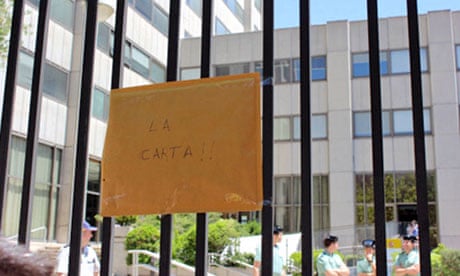
También le devuelvo la carta que la Fundación Española para la Ciencia y la Tecnología tuvo el detalle de enviarme hace unas semanas a mi antigua dirección en la Universidad de Princeton. El objetivo de dicha misiva es realzar la “marca España” con un programa denominado “Ciencia Española en el Exterior”. Sepa usted que me trasladé a España hace cinco años y cuando emigre próximamente la ciencia que haga ya no será española, ni será gracias a España; seguiré haciendo ciencia a pesar de España.
Por último, y a cambio de todos estos documentos que le devuelvo, le pido tan sólo una cosa: devuélvame usted mi dignidad como investigadora, y en el mismo envío, si no le es mucha molestia, devuélvasela a toda la comunidad de investigadores en España, y no se olvide de los de humanidades.
We’re fortunate that Spain leads the crusade for academic degree validations — beyond our borders any academic degree from a reputable university is valid, a real scandal.
I am also sending you the 700 pages of certificates and documents requested to certify the veracity of my curriculum vitae, which, due to the hiring freeze, I will no longer need. Collecting all this documentation was a tremendously satisfying research project. You should know that, with the many jobs that I have applied for outside Spain, the requested documentation is slightly briefer, approximately 10 pages: a research plan and a short curriculum vitae that does not need to be backed up with certificates, because the research community operates on an honour code (I am happy to explain this principle to you if you wish).
I’m also returning the letter that the Spanish Foundation for Science and Technology (FECYT) thoughtfully sent to my old email address at Princeton a few weeks ago. The goal of this missive was to promote the brand of Spain with a programme called “Spanish Science Abroad”. Please let them know that I moved back to Spain five years ago — and when I emigrate shortly, the science I will do will no longer be Spanish, nor thanks to Spain; rather I will keep doing science in spite of Spain.
Finally, in exchange for all these documents I’m giving you back, I make just one request: please give me back my dignity as a researcher. At the same time, if it is not too inconvenient, please give that dignity back to everyone in the research community in Spain, and please do not forget those in the Humanities.

Sunday, 9 December 2012

Sir Patrick Moore (1923—2012)

Moore was perhaps the last in the great British tradition of significant contributions to science by distinguished amateurs, and was fiercely proud of his amateur status.

I wonder what academic bureaucrats of today would make of Sir Patrick Moore’ CV if he ever applied for professorship. Moore never went to the university (he famously refused a government grant to study at Cambridge), let alone wrote a Ph.D. thesis. So what. Dennis Barker wrote in The Guardian:

With one exception after his teaching days — his directorship of Armagh Planetarium in Northern Ireland (1965—68) — Moore was never an employee.

Even better.

I first learned about Moore from Англия, a British magazine published (in Russian) in Soviet times. I remember the black and white photo of him by the grand piano, the caption saying that Moore is an accomplished musician possessing perfect pitch. Back then, I thought he was some sort of English eccentric. Many years later, I saw him on the BBC. Yes he was an archetypal English eccentric all right, and amazingly brilliant at that. He joined the RAF during World War II; he met Yuri Gagarin and appeared in Doctor Who. He was the world’s longest-serving TV presenter — and, briefly, the finance minister for the Monster Raving Loony Party. According to Wikipedia, “as a pianist, he once accompanied Albert Einstein playing The Swan by Camille Saint-Saëns on the violin”. He wrote hundreds of books, including the one called Bureaucrats: How to Annoy Them. So I think his application would not be successful.

Sunday, 13 September 2009

карта звезды

When I was about four years old, I was drawing all the time. Once, in kindergarten, I was creating another masterpiece of an illustrated sci-fi book, which included the map of a star.