Showing posts with label authorship. Show all posts

Friday, 16 April 2021

this is the extent of serendipity

According to Wikipedia, Charles J. Pedersen (1904—1989) “is one of the few people to win a Nobel Prize in the sciences without having a PhD”. Pedersen received the Nobel Prize in Chemistry in 1987, twenty years after he published his classic paper on crown ethers [1].

Revisiting his work for Current Contents® (remember them?), he wrote [2]:

In 1961, at age 57, I began to study the effects of uni- and multidentate phenolic ligands on the catalytic properties of the VO group. The desired ligands, up to and including the quadridentate, had been synthesized. Now, the quinquedentate ligand, bis[2-(o-hydroxyphenoxy)ethyl] ether, was to be prepared by reacting a catechol derivative containing a protected hydroxyl (contaminafed with 10 percent catechol) with bis(2-chloroethyl) ether. The expected quinquedentate ligand was obtained, but nature lent a hand to provide the hexadentate dibenzo-18-crown-6 in 0.4 percent yield. This is the extent of serendipity.
Other crown ethers were synthesized, and when their unique properties had been determined, an exhilarating period of research was inaugurated: every successful experiment produced a significantly novel result.
The crown ethers might have been stillborn in another environment. They were discovered in the Elastomer Chemicals Department of E. I. du Pont de Nemours and Company, but what had they to do with elastomets? Moreover, the small amount of the byproduct might have been tossed out or disregarded as something other than the desired product. However, with the support of the top departmental management (C.J. Harrington, A.S. Carter, H.E. Schroeder, and R. Pariser), I worked independently with these compounds for nearly eight years. During the period leading to the paper, my sole coworker was T.T. Malinowski, a laboratory technician. I also had the resources of the analytical groups and the chance to consult with anyone on the technical staff of the company.
The editor of the Journal of the American Chemical Society, Gates Marshall, wrote of the manuscript: “You are clearly reporting a monumental piece of work...” But he complained that the experimental section “...looked as though it had been copied verbatim from a laboratory notebook.” He contributed to the frequency of citation by allowing two unusual features in the paper: length (20 pages) and a new system of nomenclature (crown) for identifying compounds whose official names boggle the mind.

I don’t know about you but I find all this astounding. A guy sans Ph.D. is allowed to work for eight years on something that has nothing to do with his company’s products. Two years before his retirement, he publishes a single-author experimental paper on synthesis and characterisation of 33 cyclic polyethers, plus proposes the new nomenclature system for crown ethers that we still use today. It is as if the management knew he’s gonna win the Nobel and just let him work toward it.

References

  1. Pedersen, C.J. (1967) Cyclic polyethers and their complexes with metal salts. Journal of the American Chemical Society 89, 7017—7036.
  2. Pedersen, C.J. This Week’s Citation Classic. Current Contents®, no. 32, August 12, 1985, p. 18.

Sunday, 2 June 2019

our work on relative motion

“I need my wife. She solves for me all my mathematical problems”, Albert Einstein used to say [1]. What?

I have to admit that until today I knew literally nothing about Mileva Marić (1875—1948). It was thanks to publication of Rosa Montero in El País Semanal [2] that I looked her up. Her life was fascinating and tragic. Quite apart from being a brilliant mind, her husband was an ordinary asshole.

I look forward to resume our new common work. You must now continue with your research — how proud I will be to have a doctor for my spouse when I’ll only be an ordinary man.
Albert Einstein to Mileva Marić, September 1900 [1]
We will send a private copy to Boltzmann to see what he thinks and I hope he will answer us.
Mileva Marić to Helene Savić, 20 December 1900 [1]
How happy and proud I will be when the two of us together will have brought our work on relative motion to a victorious conclusion.
Albert to Mileva, 27 March 1901 [1]
<Michele Besso> visited his uncle on my behalf, Prof. Jung, one of the most influential physicists in Italy and gave him a copy of our article.
Albert to Mileva, 4 April 1901 [1]
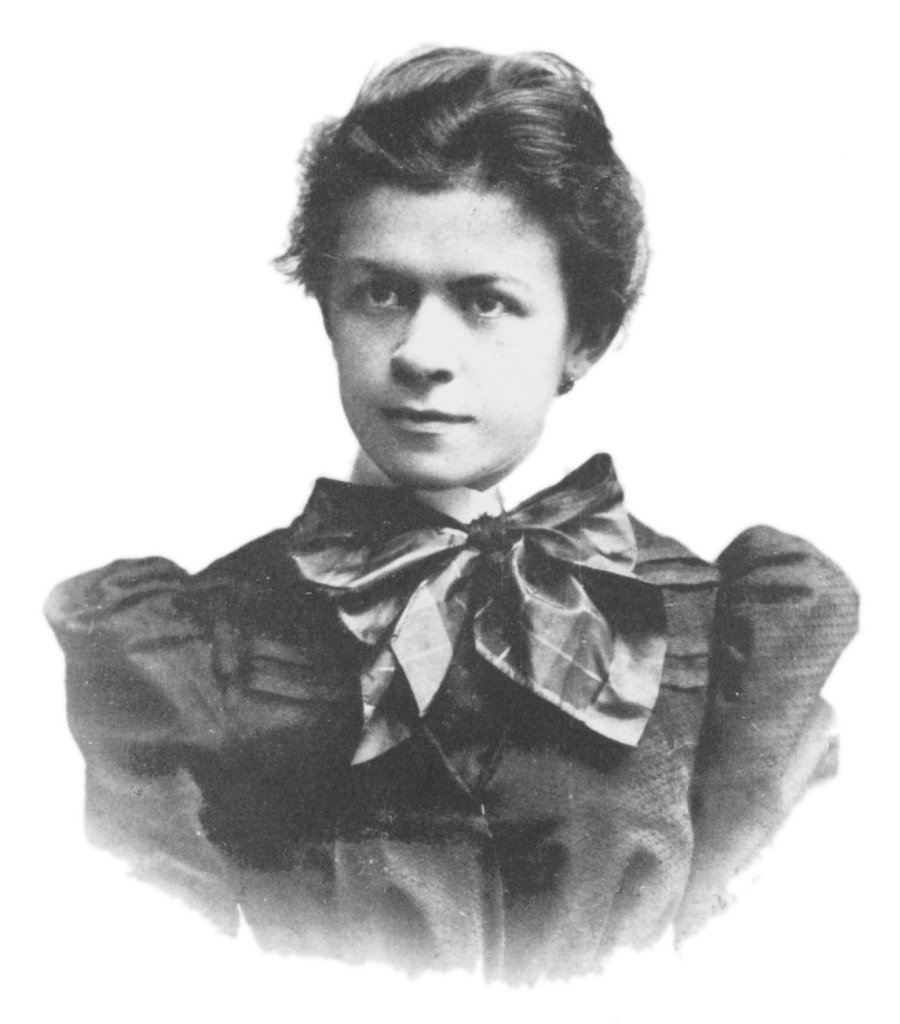
Marić in 1896

Whatever was Mileva’s actual contribution, we may never learn. Einstein submitted articles signed by his name only. Abram Ioffe claimed that “he saw the original three submission papers of the 1905 theory of relativity paper and said they were signed Einstein-Marity <Hungarian variant of Marić>. However, Marity was removed from the final publication” [3].

In 1912, Albert embarked on an affair with his first cousin, Elsa Einstein (Löwenthal). He forced Mileva to sign a humiliating contract [4, 5]:

  1. You will make sure:
    1. that my clothes and laundry are kept in good order;
    2. that I will receive my three meals regularly in my room;
    3. that my bedroom and study are kept neat, and especially that my desk is left for my use only.
  2. You will renounce all personal relations with me insofar as they are not completely necessary for social reasons. Specifically, You will forego:
    1. my sitting at home with you;
    2. my going out or travelling with you.
  3. You will obey the following points in your relations with me:
    1. you will not expect any intimacy from me, nor will you reproach me in any way;
    2. you will stop talking to me if I request it;
    3. you will leave my bedroom or study immediately without protest if I request it.
  4. You will undertake not to belittle me in front of our children, either through words or behavior.
“Mileva moved back to Zurich with her two sons on 29 July 1914. In 1919, she agreed to divorce, with a clause stating that if Albert ever received the Nobel Prize, she would get the money. <...> In 1925, Albert wrote in his will that the Nobel Prize money was his sons’ inheritance. Mileva strongly objected, stating the money was hers and considered revealing her contributions to his work” [1]. Here’s what her ex responded:
You made me laugh when you started threatening me with your recollections. Have you ever considered, even just for a second, that nobody would ever pay attention to your says if the man you talked about had not accomplished something important. When someone is completely insignificant, there is nothing else to say to this person but to remain modest and silent. This is what I advise you to do.
Albert to Mileva, 24 October 1925 [1]

References

  1. Gagnon, P. The forgotten life of Einstein’s first wife. Scientific American, 19 December 2016.
  2. Montero, R. Ella también. El País Semanal, 2 June 2019.
  3. Banovic, R. Does Albert Einstein’s first wife Mileva Maric deserve credit for some of his work? Independent, 13 June 2018.
  4. Smith, D. Dark side of Einstein emerges in his letters. The New York Times, 6 November 1996.
  5. Isaacson, W. Einstein: His Life and Universe. Simon & Schuster, New York, 2007.

Friday, 13 September 2013

important scholarly considerations

From Portuguese Irregular Verbs by Alexander McCall Smith:

It was the lowest form of work in the academic hierarchy, made all the more difficult by the tendency of Professor Vogelsang to publish papers based almost entirely on von Iglefeld’s work, but under the Vogelsang name and with no mention made of von Igelfeld’s contribution. In one case — which eventually prompted von Igelfeld to protest (in the gentlest, most indirect terms) — Vogelsang took a paper which von Igelfeld asked him to read and immediately published it under his own name. So brazen was this conduct that von Igelfeld felt moved to draw his superior’s attention to the fact that he had been hoping to submit the paper to a learned journal himself.

‘I can’t see why you are objecting,’ said Vogelsang haughtily. ‘The paper will achieve a far wider readership under my name than under the name of an unknown. Surely these scholarly considerations are more important than mere personal vanity?’

As he often did, Vogelsang had managed to shift the grounds of argument to make von Igelfeld feel guilty for making a perfectly reasonable point. It was a technique which von Igelfeld had himself used on many occasions, but which he was to perfect in the year of his assistantship with Professor Vogelsang.

Friday, 26 March 2010

crowdsourcing

There are only a few buzzwords which irritate me more than this one. But what exactly is crowdsourcing? According to Wiktionary, it means “delegating a task to a large diffuse group, usually without substantial monetary compensation”.

Friday, 14 August 2009

a threat to scientific communication

Once again, I am getting spammed by Nature — this time it is an email with a modest subject “Impact Factor confirms Nature is top research journal”. It informs me that its Impact Factor is 31.434 now. The reason they bother to send me this?

To celebrate we are offering you an exclusive 30% discount if you subscribe to Nature this week.

No thank you.

Sunday, 19 July 2009

academic matters

Idly browsing the web (as usual), I came across Academic Matters, the open access Canadian magazine. The latest (May 2009) issue is devoted to Ethics in the Academy. Incidentally, this enjoyable article by Sergio Sismondo deals with issue of ghosts in some detail.

Academic authors are well versed in the art of multiplying papers and, also, with complaining about it. However, in the pharmaceutical industry each publication is part of a marketing campaign and has an expected return. The professionalization and commercialization of publishing makes a science out of the multiplication of papers.

Sunday, 12 July 2009

guests, ghosts, gofers

Thanks to this paper by Peter R. Mason from Zimbabwe, I got acquainted with an interesting classification of the authorship of (scientific) papers.

Guest authors are those “important” persons who insist that their names appear on the papers of their juniors, even when they have made minimum contribution to the research. Ghost authors are those who make a significant contribution to the writing of a paper, but their names do not appear as an author on the publication. This is often a situation found in clinical trials sponsored by pharmaceutical companies. A “gofer” is a name given to someone who is regarded as very junior and so is sent to “go for” something and bring it back to the more important members of a team.